I’m writing this the way I wish someone had explained it to me before my first drive in Portugal: clear, practical, and focused on what matters most.
If you haven’t chosen your rental yet (or you’re deciding between a smaller city car vs something more comfortable for motorways). Compare car rental options in Portugal.
The 60-second cheat sheet (save this)
Portugal driving basics:
- Drive on the right.
- At roundabouts, cars already circulating have priority.
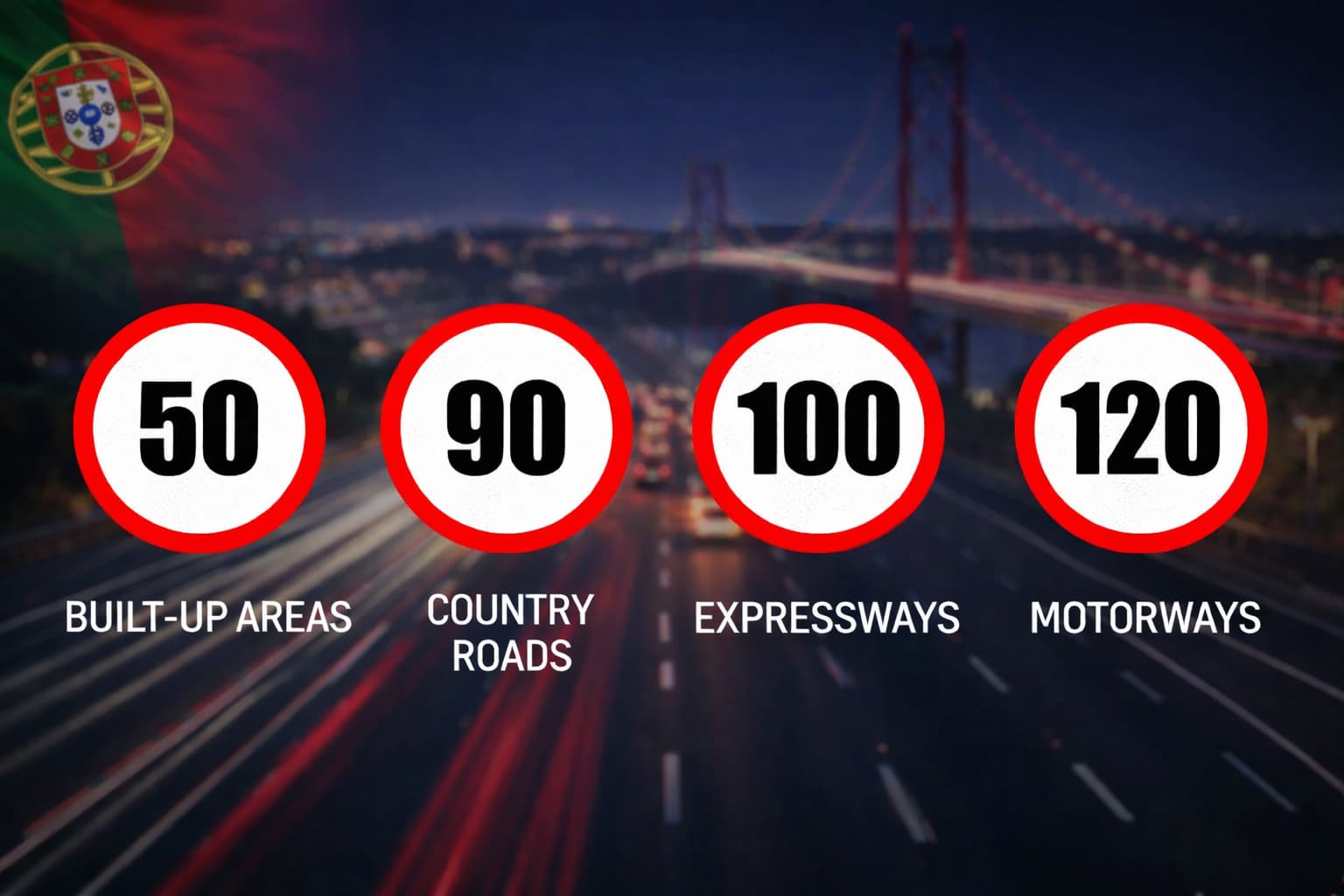
- Common speed limits for cars (no trailer): 50 (cities) / 90 (regular roads) / 100 (expressways) / 120 (motorways).
- Using/handling a phone while driving can mean €250–€1250 fine.
- Alcohol: illegal from 0.5 g/L (standard drivers).
1) Speed limits in Portugal (and why they feel “strict”)
Most of the time, Portugal feels easy to drive—until you enter a town, hit a short stretch of motorway roadworks, or go through a zone with extra signage. My personal “Portugal habit” is to trust the posted signs more than assumptions, because limits can step down quickly.
Typical speed limits (cars without trailers)
These are the standard headline numbers most travelers need:
- 50 km/h – built-up areas
- 90 km/h – normal roads
- 100 km/h – roads reserved to motor vehicles / expressways
- 120 km/h – motorways
Tip from experience: if you’re unsure, match the flow but not the fastest driver. Some locals drive confidently; the enforcement doesn’t always care that “everyone was doing it.”
Speeding fines (what the Highway Code actually says)
Portugal’s Highway Code sets fine ranges depending on how much you exceed the limit. For cars/motorcycles, the fine ranges can go from €60–€300 (lower overages) up to €500–€2500 (high overages).
2) Roundabouts in Portugal (the #1 place tourists hesitate)
Roundabouts are everywhere—especially near cities and on bigger junctions—and the rule is simple once you know it:
Priority rule
You enter only after yielding to vehicles already on the roundabout.
Lane choice (the “Portugal difference” many miss)
Portugal’s Highway Code (Article 14-A) spells out positioning:
- If you plan to exit at the first exit, take the right-hand lane.
- If you plan to exit later, you generally stay left/inner and only move right after passing the exit before yours, approaching progressively and safely.
My real-world advice: if you miss your exit, don’t panic—just go around again. It’s normal, and it’s safer than a last-second dive across lanes.
3) Mobile phone rules (hands-free isn’t a “free pass”)
Portugal is strict about phone handling, and the law is written in a way that catches the most common tourist mistake: touching the phone “just for a second.”
The Highway Code prohibits continuously using or handling devices that can impair driving (including radio-telephones / phones), with limited exceptions (like a single earpiece/mic system that doesn’t require continuous handling).
The fine for breaking this rule is €250–€1250.
What I do personally: set navigation before moving, and if you need to change something, pull into a safe spot and park. It’s not worth the stress.
4) Alcohol limits (don’t “guess” — Portugal treats this seriously)
Portugal’s official tourism guidance is very clear: it’s illegal to drive with 0.5 g/L blood alcohol level or more.
The Highway Code also defines being under the influence from 0.5 g/L.
What happens if you’re over the limit?
According to VisitPortugal:
- 0.5–0.8 g/L is a serious offence, with driving inhibition and a fine range €250–€1250.
- 0.8–1.2 g/L is very serious, with stronger inhibition and €1250–€2500 fine range.
- 1.2 g/L or more is considered a crime, potentially with imprisonment or a fine penalty and longer driving inhibition.
New drivers / probationary driving licence
Portugal has a probationary regime for the first three years of a new driving licence.
Some official/educational materials used in Portugal explain that the permitted alcohol level is reduced to 0.2 g/L for drivers in probationary regime and certain professional categories.
Practical advice (my rule): if I’m driving in Portugal, I treat it as zero alcohol. It keeps the trip simple.
5) Right of way: intersections and “priority from the right”
In Portugal, unless signs say otherwise, vehicles coming from the right have priority at squares and intersections.
This is one of those rules that matters more in smaller towns and quieter roads—exactly where tourists love to drive.
6) Seat belts and documents (what you should have ready)
Seat belts
All occupants must wear seat belts.
Documents
VisitPortugal lists typical compulsory papers such as:
- ID (passport / EU ID)
- Driving licence
- Insurance certificate
- Proof of vehicle registration/ownership (or equivalent)
- Proof of periodic inspection (MOT)
Also note: on-the-spot fines are issued in Portugal.
That’s why I keep my documents accessible (not buried in luggage).
7) My “safe and calm driving” habits in Portugal (simple, but effective)
These aren’t laws—just habits that made my road trips smoother:
- In cities (especially Lisbon/Porto), I avoid driving into the historic core unless my hotel has confirmed parking.
- I assume roundabouts require patience and signalling early.
- I treat the phone like it’s “sealed away” while the car is moving.
- I plan motorway stretches with breaks—Portugal can tempt you into longer drives than expected.
And if you’re choosing the right vehicle for your route (city compact vs motorway comfort vs extra luggage space), it’s worth comparing before you book: check car options.
FAQ (what people ask about driving in Portugal)