First thing you’ll want to know: are there toll roads in Tenerife?
Good news: no toll roads. None. Zero.
I know everyone Googles this because in so many places in Europe you suddenly hit a toll booth or some electronic system and you’re like, “Wait, what?” But Tenerife (and the Canary Islands in general) doesn’t really play that game. The big roads you’ll use like the ones connecting the south resorts to Santa Cruz or up toward the north are free.
So don’t budget for tolls. Budget for:
- fuel
- parking (sometimes)
- and maybe a garage fee here and there if you want to save time and stress
That’s it.
The real “tourist trap” isn’t tolls – it’s parking
If you’re going to have any friction while driving in Tenerife, it’s parking. Not because it’s impossible, but because it’s easy to assume it works like your last holiday destination… and then you get a ticket, or worse, you come back and your car is gone.
Let me break parking down in a super practical way.
1) Free street parking (unmarked)
You’ll find a lot of free street parking, especially outside the densest tourist areas. But in the busiest places (beaches, old towns, famous viewpoints), it can feel like everyone is on the same mission: find one free spot and guard it with their life.
My tip? If you’re hunting free parking:
- Go a bit uphill from the coastline (people hate walking back uphill)
- Park 10–15 minutes away and treat it like a normal walk
- Arrive early (before 10:00) or later in the day when people leave
This single change saves you a lot of time.
2) Paid street parking (what tourists call “blue zone”)
You’ll often see paid parking areas where you need to buy a ticket from a machine and display it. Some towns use apps, some don’t but the logic is usually:
- there are signs explaining the rules
- there’s a machine nearby (sometimes around the corner)
- you pay for a time period
- you display a ticket on the dashboard
The biggest tourist mistake: paying and then not displaying properly, or assuming “it’s fine for 10 minutes.”
Nope. Enforcement can be surprisingly efficient in tourist-heavy spots.
3) Resident-only parking
This is where people get burned because it looks “too good to be true.”
You’ll see streets full of empty spots and think you’ve won the lottery — and then you notice a sign that basically means: residents only, permit required.
Don’t gamble on it. If it’s for residents, it’s not your parking.
4) Garages / underground car parks (underrated lifesaver)
I used to avoid paid garages because I thought it’s “a waste,” but honestly? In busy areas, a garage is sometimes the cheapest option because:
- you don’t waste 30 minutes circling
- you don’t risk fines/towing
- you don’t start your day annoyed
If you’re going somewhere popular mid-day and you want it to be smooth, just go garage.
The “please don’t do this” parking mistakes I see all the time
Here’s what gets tourists into trouble most often:
Blocking driveways or narrow roads (even a little)
Some streets are tight. Even if you think “there’s space,” locals need to get through. If you block access, towing becomes a real possibility.
Parking where it “looks okay” but signage says no
Trust the sign, not your instincts.
Bus stops, taxi zones, loading zones
These are not suggestions. These are “you’ll get punished” zones.
Parking near popular hikes/viewpoints when it’s full
This is where people start parking creatively: half on the shoulder, awkward angles, “just for a minute.”
That’s exactly when enforcement shows up.
Rule of thumb: If your parking feels slightly illegal, it probably is.
What if the car gets towed?
This is the nightmare scenario because it instantly turns into a half-day mission.
If you come back and the car is missing:
- First, don’t jump straight to “stolen.” It might be towed.
- Look around for signs about towing enforcement
- Ask nearby businesses or locals (someone usually knows what happens on that street)
- Call local police (non-emergency) or go to a police station
- Contact your rental company they sometimes get notified
You’ll likely need:
- your ID
- rental agreement
- payment for towing/impound fees
The painful part isn’t just the money it’s the time. Which is why in busy areas I’m pro-garage.
Let’s talk about fines, what tourists actually get fined for
Most people don’t get fined for dramatic reckless driving. It’s usually boring stuff:
1) Speeding (especially when limits change)
This catches people because you’ll be cruising comfortably and then:
- you approach a town
- the speed limit drops
- you don’t notice quickly enough
If you drive a lot on TF-1 or TF-5 and then exit toward towns, pay attention. That transition zone is where mistakes happen.
2) Parking tickets (paid zone issues)
Common reasons:
- didn’t pay
- paid but didn’t display correctly
- overstayed the time
- parked in resident-only space
3) Phone use
If you’re changing maps, do it safely. Pull over or let a passenger handle it.
4) Seatbelts / child seats
Rental companies usually offer child seats use them properly. This is an easy one to avoid entirely.
Are speed cameras a thing in Tenerife?
Yes. You may not see them constantly, but they exist, and the main thing to understand is: they tend to be placed where speeding is likely, like:
- on stretches where people naturally speed up
- near urban transitions
- on routes with accident risk
Also: Tenerife has a lot of downhill driving, and on downhills your speed can creep without you noticing. If you’re coming down from higher areas, watch the speedometer more than you think you need to.
The big question: what happens if you get a ticket in a rental car?
This part stresses everyone out, so here’s the simple version.
If you get stopped by police. You’ll be issued something directly, like any driver would. You’ll get instructions for payment or next steps. Straightforward. If it’s a camera ticket (most common fear)
Here’s what typically happens:
- The ticket goes to the registered vehicle owner – which is the rental company.
- The rental company either:
– provides your details to authorities, so the ticket gets transferred to you, or
– charges you an admin/handling fee (as per contract) and sends you the notice info
Important: That admin fee is often separate from the fine itself. So the best move is prevention: park cleanly, respect speed limits, and you’ll avoid the whole “post-trip paperwork” situation.
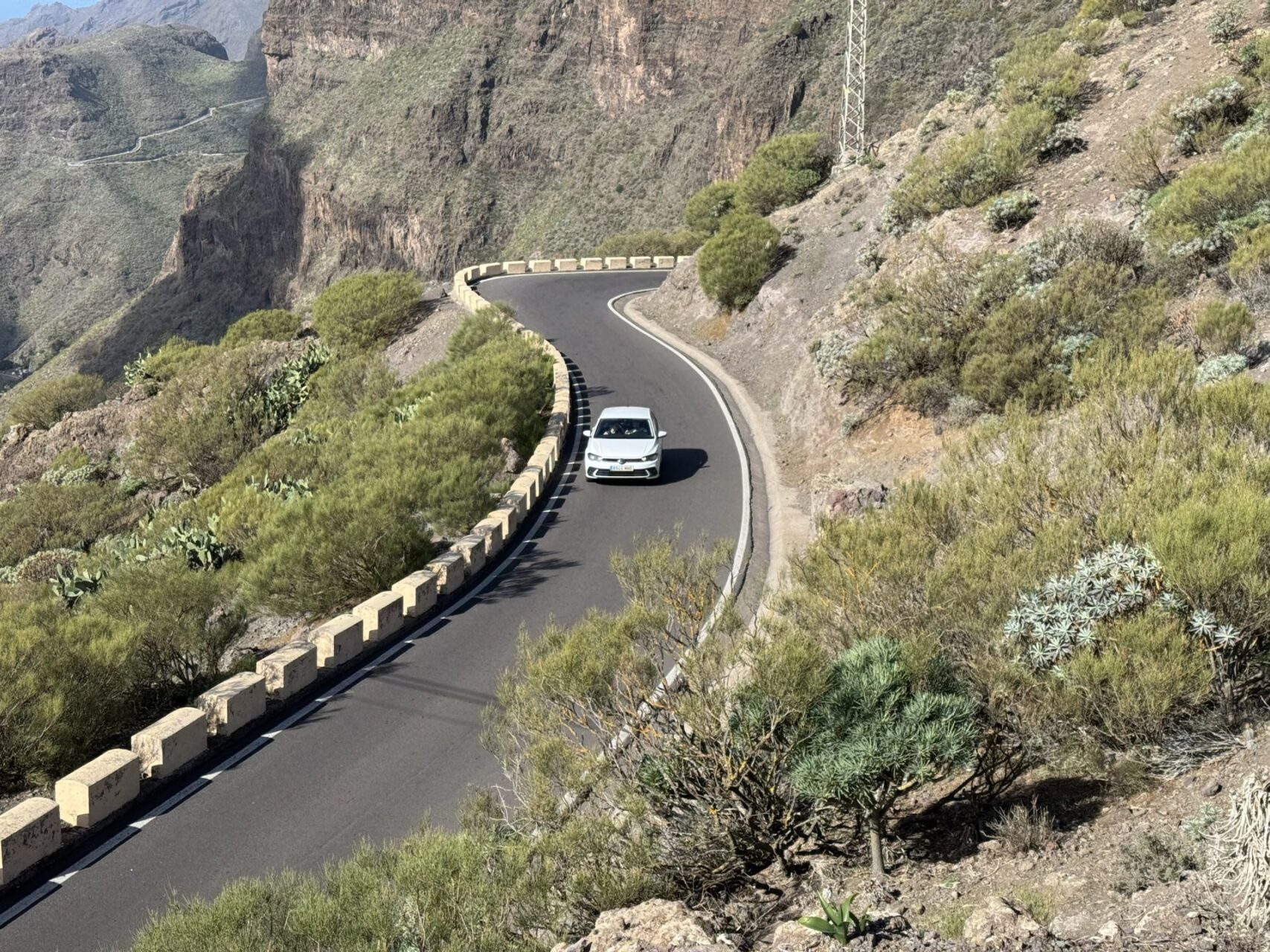
Driving in Tenerife feels easy… until you hit the mountains
The main roads are good. The signage is decent. If you’ve driven in Europe before, you’ll be fine.
But Tenerife has two things that make it unique:
1) Serious elevation changes (brakes matter)
If you’re driving up to viewpoints or heading into mountainous areas, you’ll have steep climbs and steep descents.
My advice:
- On the way down, use engine braking (drop a gear)
- Don’t ride the brakes constantly
- If you smell brakes, pull over safely and let them cool
This is the kind of island where you really appreciate a car that feels confident on hills.
2) Narrow village streets
Some towns and villages have roads that feel… personal. Like you and the wall are in a relationship now.
Drive slowly, be patient, and if you’re unsure, don’t force it. Let locals pass if needed – they know every curve.
Microclimates: you can drive from summer to sweater in 30 minutes
This one surprises people. In the south, you can be in full sun. Then you drive up toward higher ground and suddenly:
- it’s cloudy or foggy
- temperature drops
- visibility changes
This isn’t scary, just something to expect.
Keep in the car:
- a light jacket
- water
- sunglasses (because you’ll go from fog to sun fast)
Where parking is hardest (so you can plan smarter)
Some areas are just naturally tougher, especially during peak times:
- busy beaches in the south around mid-day
- Santa Cruz (city vibes = city parking problems)
- scenic villages with limited space
- popular hike starting points and viewpoints
Here’s the easiest strategy I’ve found:
- “Time-shift” your day
- Arrive before 10:00 (best)
- Or go late afternoon when others leave
- If it’s mid-day and you want zero stress: use a paid garage
It’s not glamorous advice, but it’s the difference between a smooth day and a frustrated one.
Costs: what driving really adds to your budget
Because there are no tolls, driving costs are pretty predictable.
Fuel
You’ll spend more if your days are mountain-heavy (more climbing, more braking).
Parking
Some days you pay nothing. Some days you’ll pay a little for a zone ticket or a garage. Worth budgeting for it so it doesn’t feel annoying.
The “hidden” cost: time
The most expensive part of driving in Tenerife can be time wasted hunting parking. Sometimes paying for a garage is actually the best value.
The real traveler checklist (what I’d tell my friend). If you want a no-drama Tenerife driving experience, remember this:
- No toll roads, so don’t worry about tolls
- Parking is the main thing to learn: paid zones, resident zones, garages
- Speed cameras exist – especially near town transitions
- Rental-car tickets don’t vanish – they can reach you later
- In mountains: use gears downhill, not constant braking
- Start early in popular places to avoid parking chaos
And again, if you haven’t booked the car yet: compare first. Prices can vary wildly. Start with best car here comparins in tenerife, then pick the best deal for your dates and route.
FAQ (in the way people actually ask)
Is it hard to drive in Tenerife?
Not really. Main roads are easy. The only “challenging” parts are mountain roads and tight villages, but if you drive calmly, it’s fine.