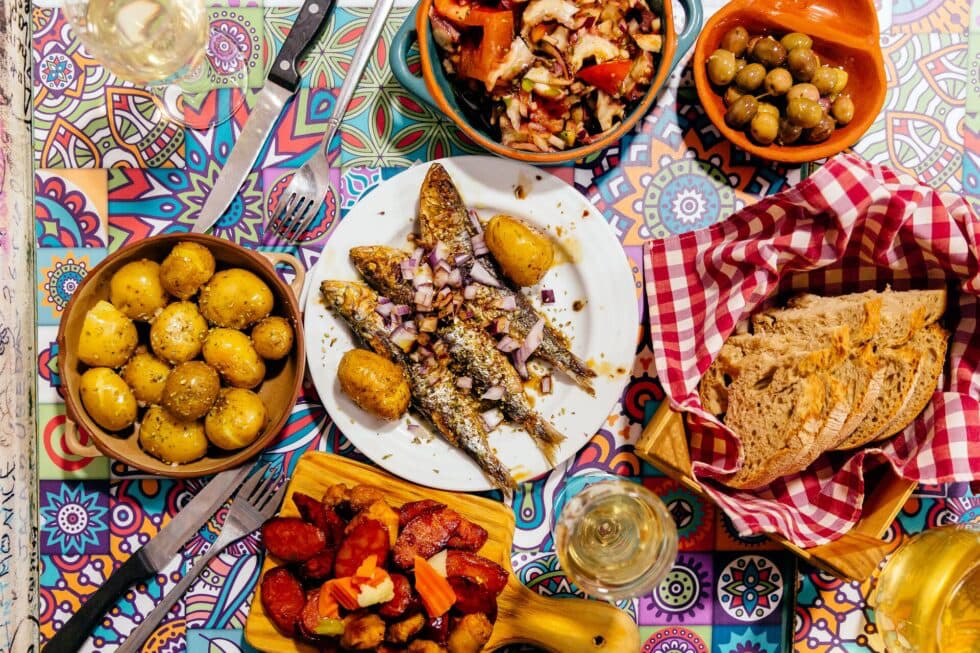
And that’s the moment most first-timers learn Portugal’s first dining lesson: the country doesn’t rush you, and it doesn’t really do “quick.”
This is a guide for travellers who want to eat well across Lisbon, Porto, and the Algarve—not in a precious, foodie-only way, but in the way that makes you remember a trip through flavours. You’ll find what to order, how local restaurants work (including the famous “wait, do I pay for this?” moments), and a simple truth that becomes obvious as soon as you leave the city: your best meal might be the one you didn’t plan.
Before Your First Meal: The Tiny Customs That Save You Money (and Awkwardness)
Let’s start with the most common surprise.
You sit down and the table gets “decorated” with bread, olives, butter, maybe cheese or pâté. It feels like a welcome gift. In many places, it’s called couvert—and you generally pay if you eat it.
It’s not a scam, and it’s not rude to decline. If you don’t want it, don’t touch it, smile and say: “Não, obrigado/a.” They’ll take it away. If you do eat it, enjoy it. It’s part of the rhythm.
The second surprise is tipping—or rather, the lack of pressure. Tipping in Portugal is usually optional. If service is great, leaving a few euros or rounding up is appreciated. If it’s a casual café or a simple lunch spot, nobody expects you to do maths.
And the third surprise is time. Portugal often eats later than many travellers expect. If you show up for dinner early and the room is empty, don’t panic—stay, order something small, and watch how the place comes alive.
Now… let’s eat.
Lisbon: Custard Tarts, Sea Air, and the Art of Snacking
Your first proper Lisbon day usually starts the same way, whether you planned it or not: you walk past a bakery, smell warm pastry, and suddenly you’re holding a pastel de nata like it’s an essential travel document.
The thing about Lisbon is that it teaches you to stop trying to “optimize” food. The best strategy is repetition. Try a nata fresh and warm. Try another the next day because someone told you it’s “the best one.” Try a third because you’re doing research, obviously.
But Lisbon isn’t just sugar and espresso. The city’s real strength is how effortlessly it moves from snack culture to seafood culture.
Order Bacalhau à Brás at least once. It’s one of those dishes that sounds odd on paper—salt cod with eggs, onions, and thin crispy potato strips—but it’s Portugal in comfort-food form. It tastes like something a friend’s family would make, which is exactly why it works.
Then, when you’re ready to lean into the Atlantic, do the simplest thing possible: ask what fish is fresh today and go with it grilled. Portugal doesn’t need complicated sauces to impress you. It has salt, olive oil, garlic, lemon, and confidence.
Lisbon dining tip that pays off: the most memorable meals often happen in places that don’t look like a “must-visit.” If the menu is short, the staff is calm, and locals are eating without photographing everything—stay.
Porto: Where Food Doesn’t Flirt, It Commits
Porto feels different from Lisbon the moment you arrive. The light is cooler. The streets feel steeper. And the food… the food is not trying to be light.
If Lisbon is a city of grazing and tasting, Porto is the city that feeds you like it’s personal.
There’s one dish you can’t avoid—so you might as well do it properly: the francesinha. Calling it a sandwich is like calling a storm “a bit of weather.” It’s layers of meat and bread, blanketed in melted cheese, then finished with a hot, savoury sauce that makes you question your life choices in the best way.
My honest advice: schedule your francesinha like an event. Eat it when you don’t need to sprint somewhere right after. If you’re travelling with someone, sharing one the first time is smart—Porto is generous.
And because Porto loves tradition, you’ll also see cod here in a hundred forms. That’s the fun: you can eat “bacalhau” multiple times and still feel like you’re trying something new.
One more Porto note, gently: port wine tastings are amazing. If you’ll be driving later the same day, plan tastings for a day when you’re not behind the wheel. Your future self will thank you.
The Algarve: Sun, Sea, and the Meals You “Accidentally” Remember Forever
The Algarve is where your trip starts to taste like the coastline. Even the simplest dinner feels like a scene: salty air, warm plates, the sound of cutlery and laughter drifting out of small restaurants.
If you see cataplana on a menu—especially seafood cataplana—take it as a sign. It arrives like a shared secret in a clam-shaped pot: clams, prawns, fish, tomato, herbs, steam. It’s built for slow eating and conversation.
Another Algarve essential is clams with garlic and coriander (often listed as Amêijoas à Bulhão Pato). It’s ridiculously simple and still somehow feels like a luxury. You’ll mop up the sauce with bread without even thinking about it, and that’s exactly the point.
Now the Algarve trick that separates “nice trip” from “how did we find this place?”:
The restaurant with the perfect beach view can be incredible… or it can be charging you for the sunset. The better-value, more local meals are often five to fifteen minutes inland. The kind of place with a short menu, no performance, and fish so fresh nobody needs to explain it.
The Quiet Upgrade: Why a Car Makes This Food Trip Better
You can do Lisbon and Porto without a car. Trains and public transport work well, and city parking can be annoying.
But if this is a food-first trip, a car quietly changes everything—especially once you’re heading into the Algarve.
A car lets you:
- detour to a small-town lunch that isn’t built for tourists,
- chase a recommendation you heard “from someone’s cousin,”
- explore the Algarve coastline without being stuck to one strip of beach restaurants,
- stop because the smell of grilled fish was too convincing to ignore.
A simple, traveller-friendly approach is: enjoy the cities first, then rent a car for the parts where freedom matters most—coastlines, villages, spontaneous stops.
If you’re comparing options for that road-trip leg, you can keep it easy by checking rentals through VerusCars—pick the right size for your luggage and route, and let the itinerary stay flexible (because the best meals rarely happen on schedule).
A Tiny Phrasebook That Makes Ordering Feel Effortless
You don’t need Portuguese to eat well here. But a few phrases feel like a superpower:
- “Um café, por favor.” (An espresso, please.)
- “A conta, por favor.” (The bill, please.)
- “Não, obrigado/a.” (No, thank you.) — perfect for declining couvert
Portugal rewards curiosity more than fluency.
Final Thought: Your Best Meal in Portugal Probably Won’t Be the One You Planned
It’ll be the meal you found because you weren’t in a rush. The one where the waiter said, “This is fresh today,” and you trusted them. The one you stopped for because the road looked good and the air smelled like garlic and the sea.
Lisbon will charm you with pastries and seafood. Porto will feed you like family. The Algarve will make you fall in love with simplicity.
And if you build even a small part of your route around food, Portugal will meet you more than halfway.
Do you pay for bread and olives in Portugal?
Often yes. Many restaurants bring couvert (bread/olives/butter/pâté) automatically, and you usually pay if you eat it. If you don’t want it, politely ask them to take it away.